Launch offer — valid today only

📄 Digital book in PDF · read it on your phone or print it

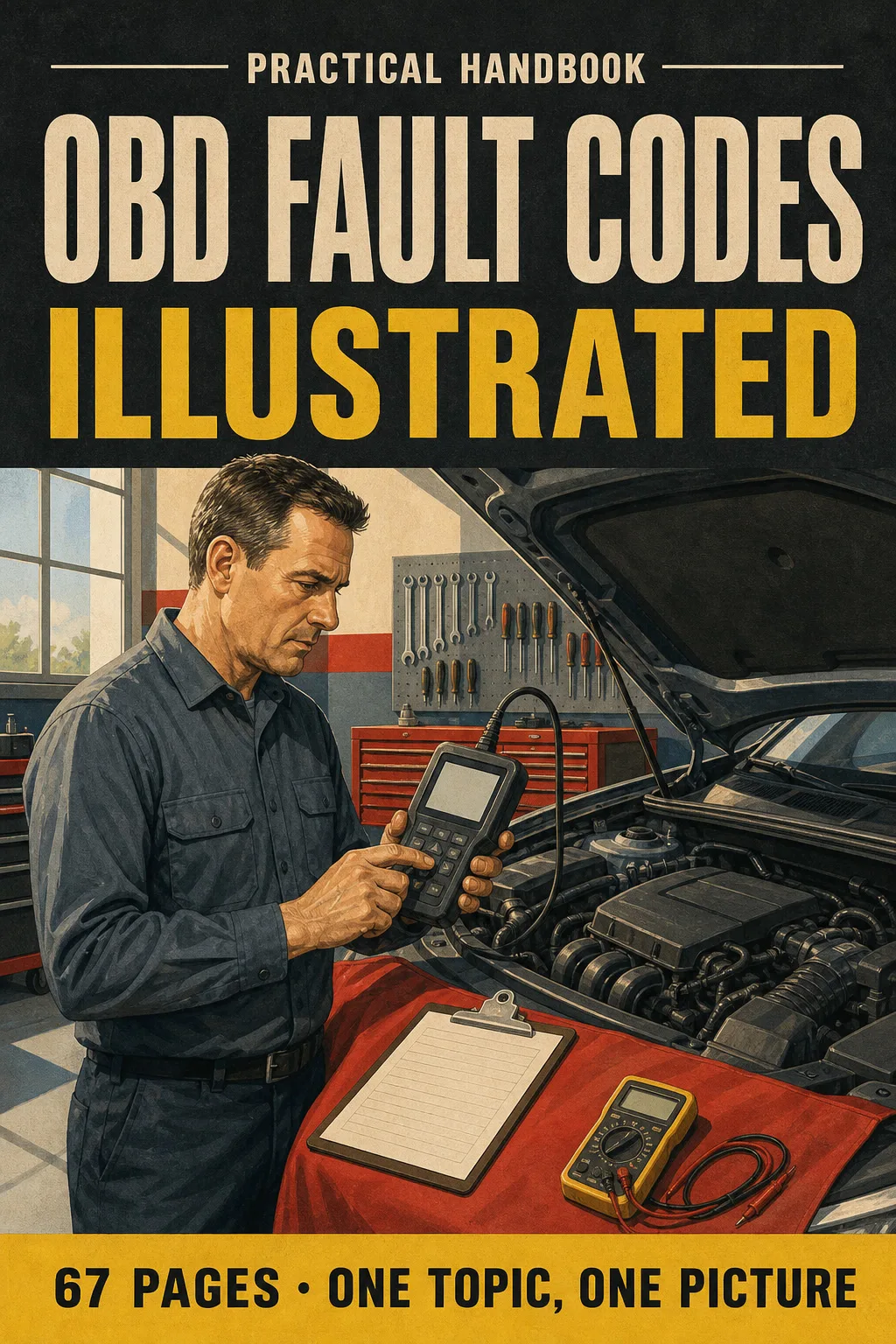
OBD Fault Codes Illustrated: Live Data and Tests in Drawings The Test Before the Part

Fuel trims, the good lambda signal, P0420, misfires and the swap test, crank and cam sensors, P0128, diesel rail pressure and boost, DPF codes, circuit low and high. Each topic has its page: the drawing first, then what you need to remember. 67 illustrated pages.

DIAGNOSE THE NEXT CAR THIS WAY

🔒 Secure checkout · PDF by email · 30-day guarantee

Every topic, its own pageEach code's test drawn, with the explanation alongside
67 illustrated pages8 parts, from what EOBD covers on UK cars to the code → page → first test index
Up-to-date sourcesSAE J2012 / ISO 15031-6 code lists and the DVSA MOT inspection manual
PDF by emailFormat

Look Inside the Book

Every page has a big drawing and a box with the values, tests and steps you need to know:

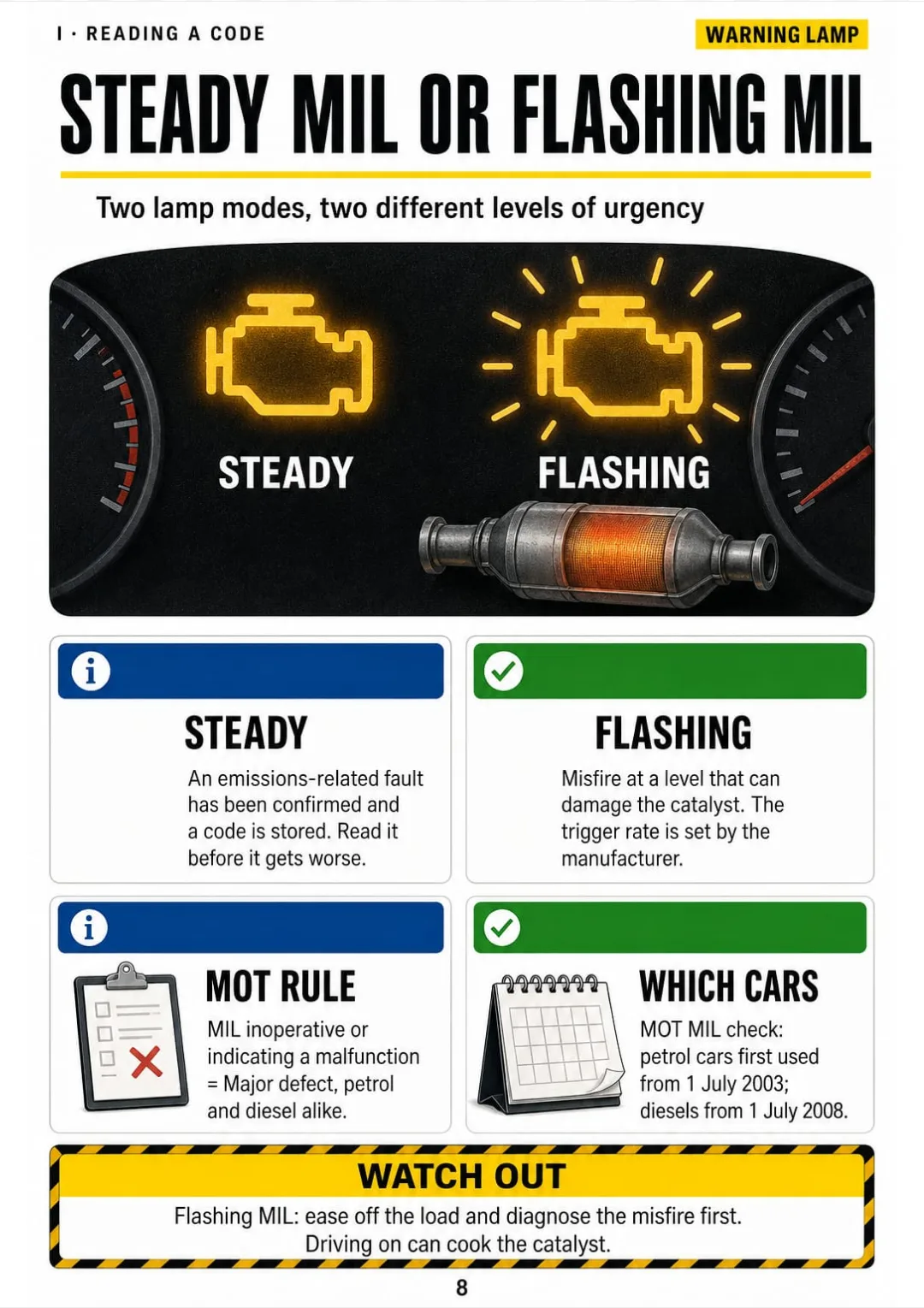
Steady = fault stored. Flashing = catalyst-damaging misfire. MIL on at the MOT = Major.
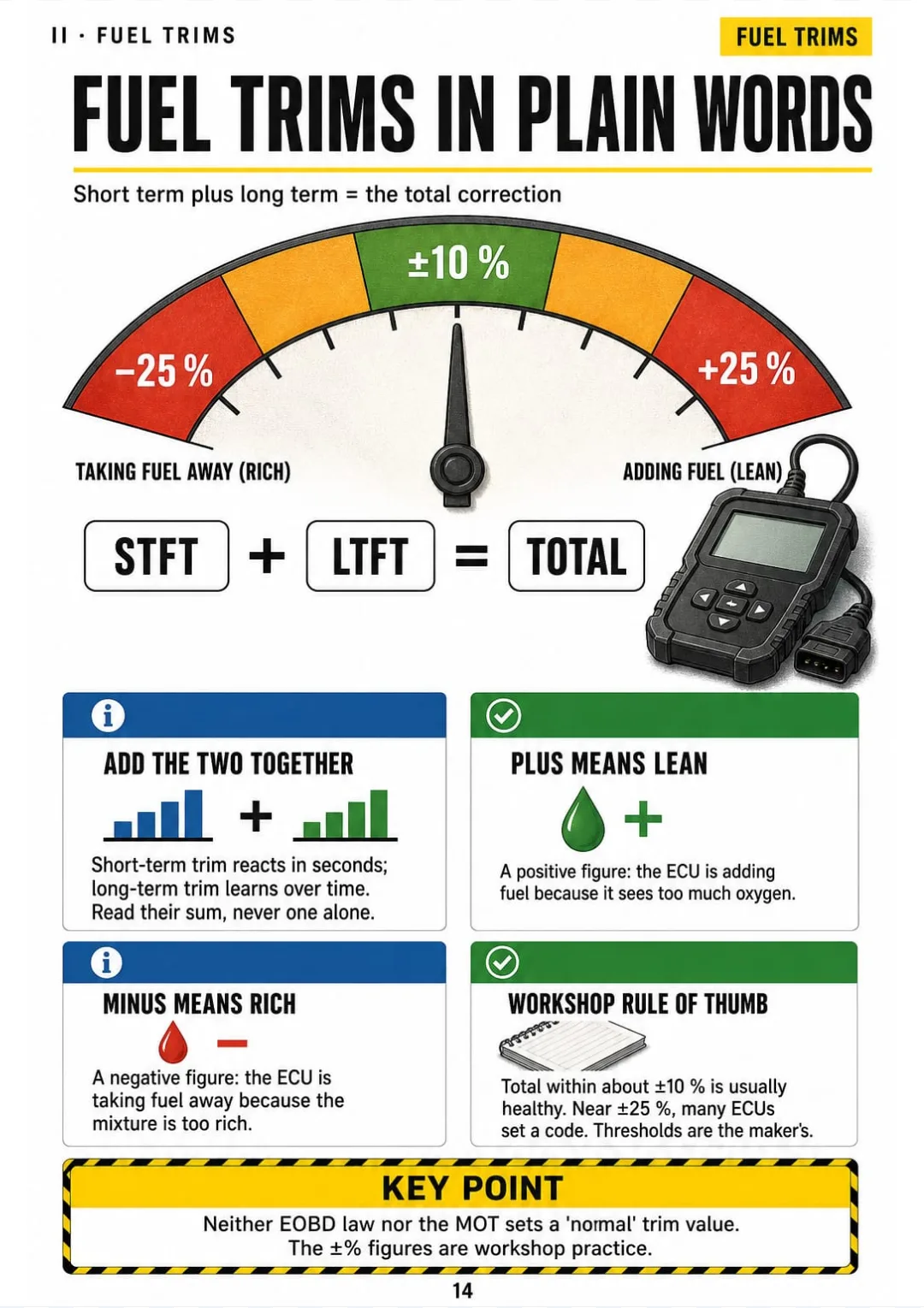
STFT + LTFT = total correction: plus is lean, minus is rich.
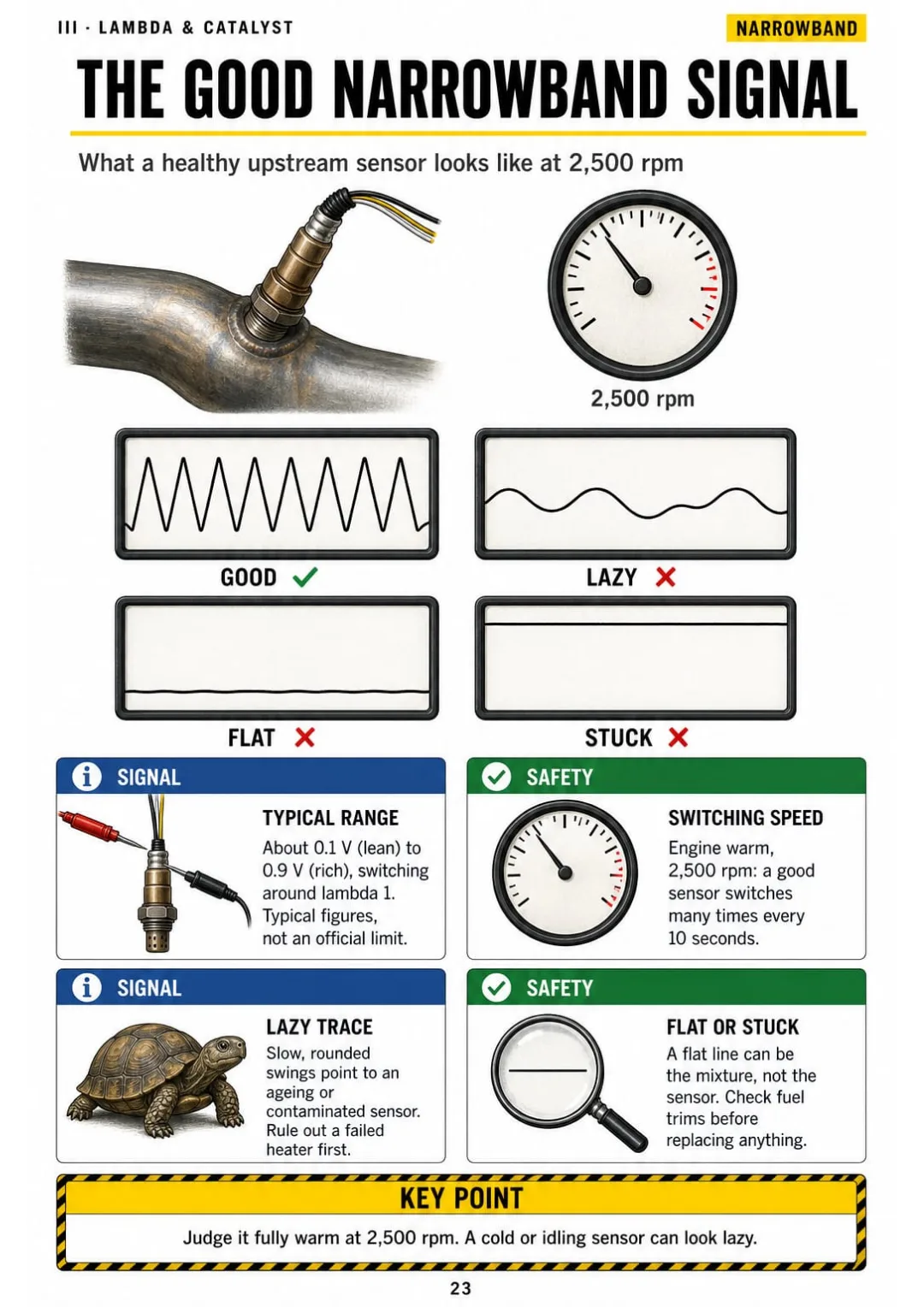
Good narrowband: 0.1–0.9 V, many switches every 10 seconds at 2,500 rpm
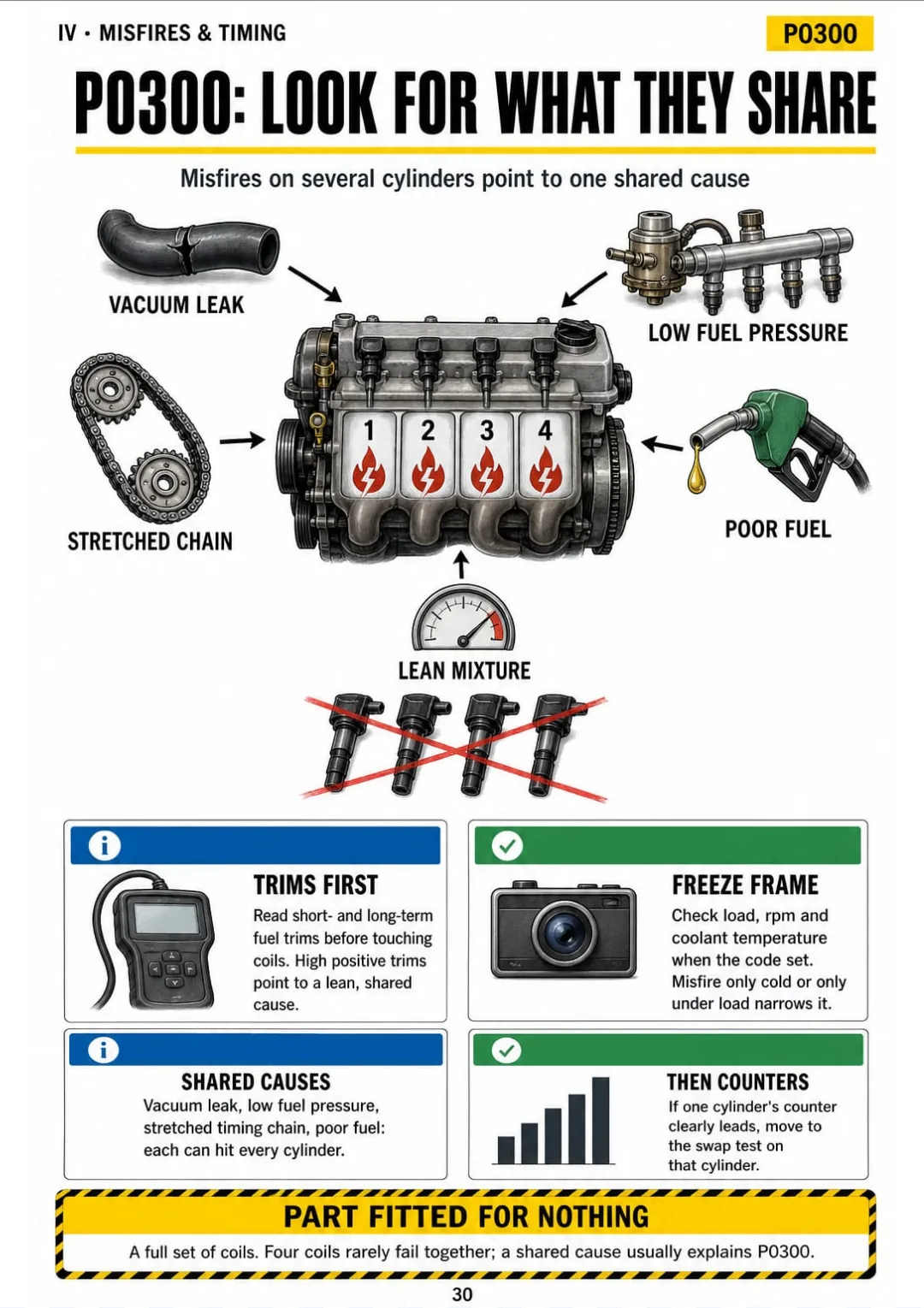
P0300: check fuel trims and shared causes before buying a set of coils
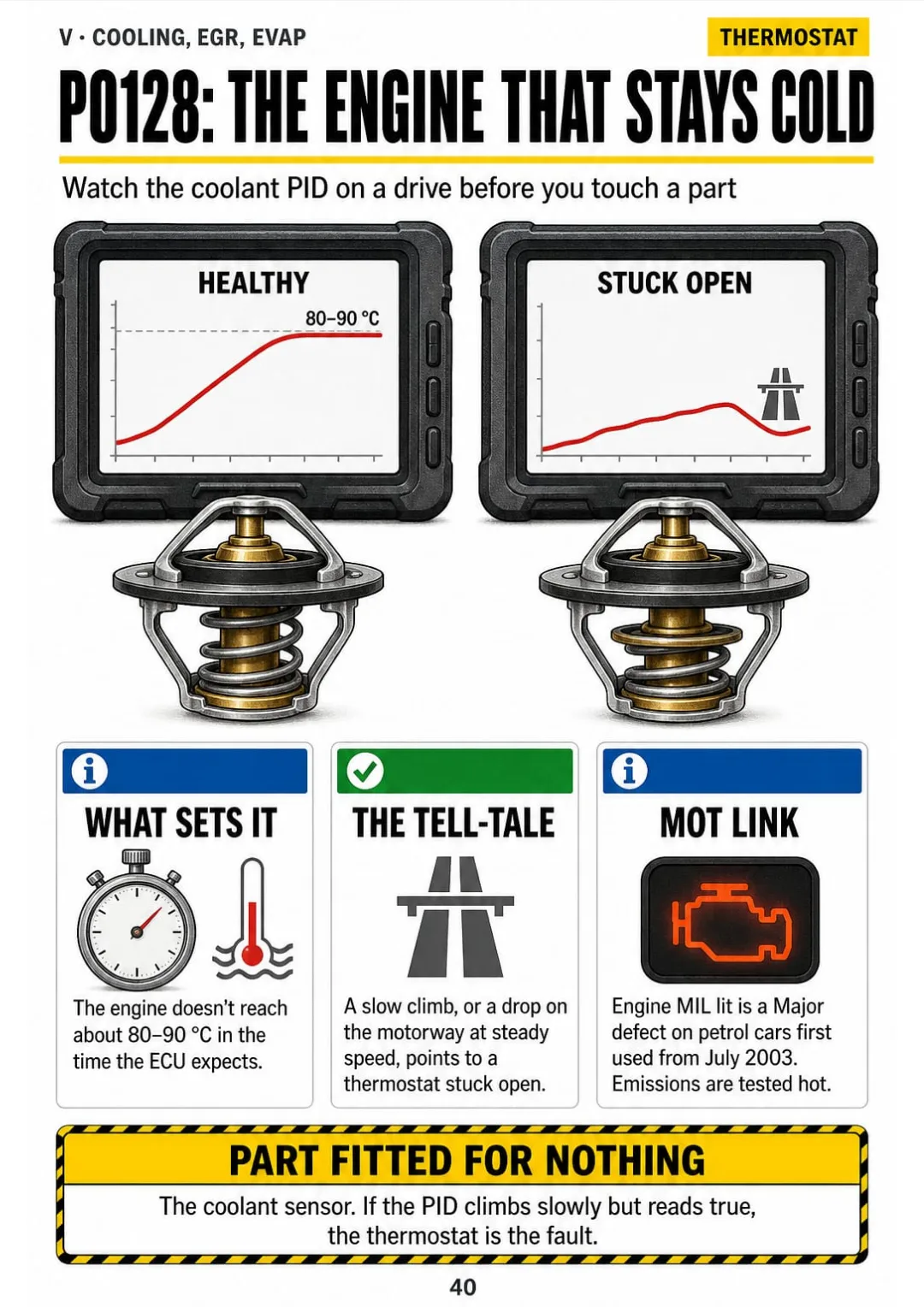
P0128: a slow climb or a motorway drop on the coolant PID means thermostat stuck open
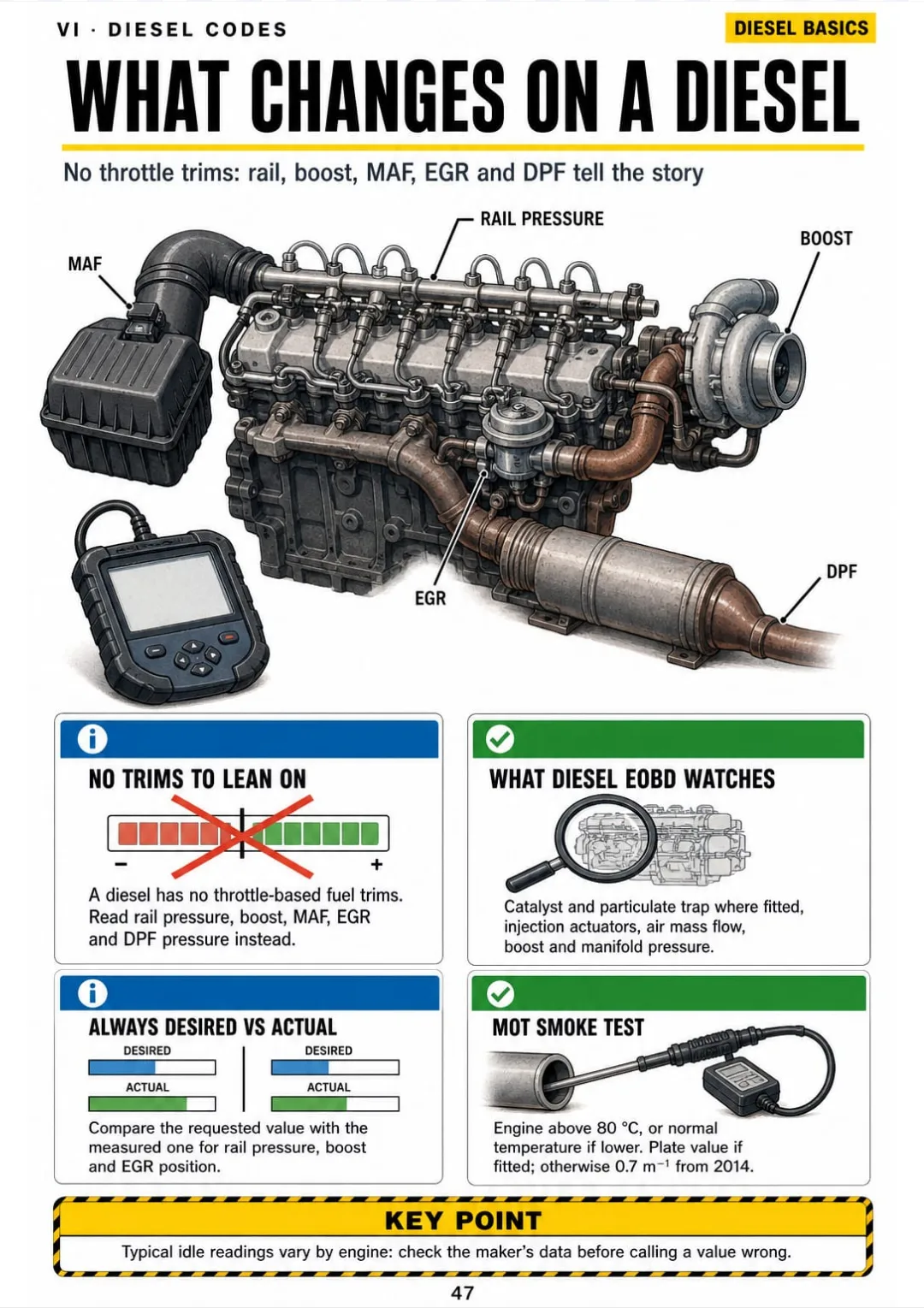
Diesel diagnosis: rail pressure, boost, MAF, EGR and DPF differential pressure
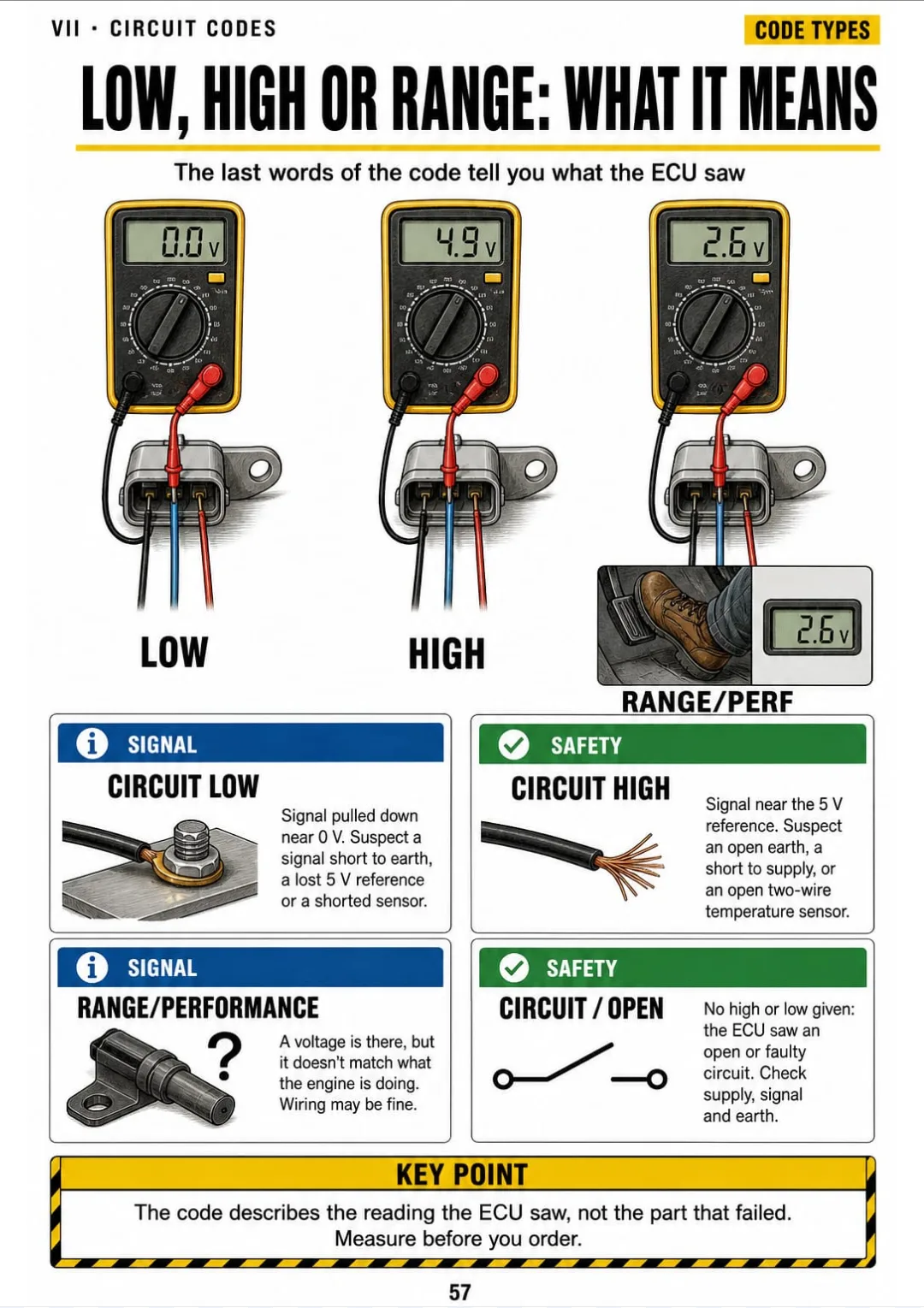
Circuit low ≈ 0 V, circuit high ≈ 5 V, range/performance = a signal that doesn't make sense
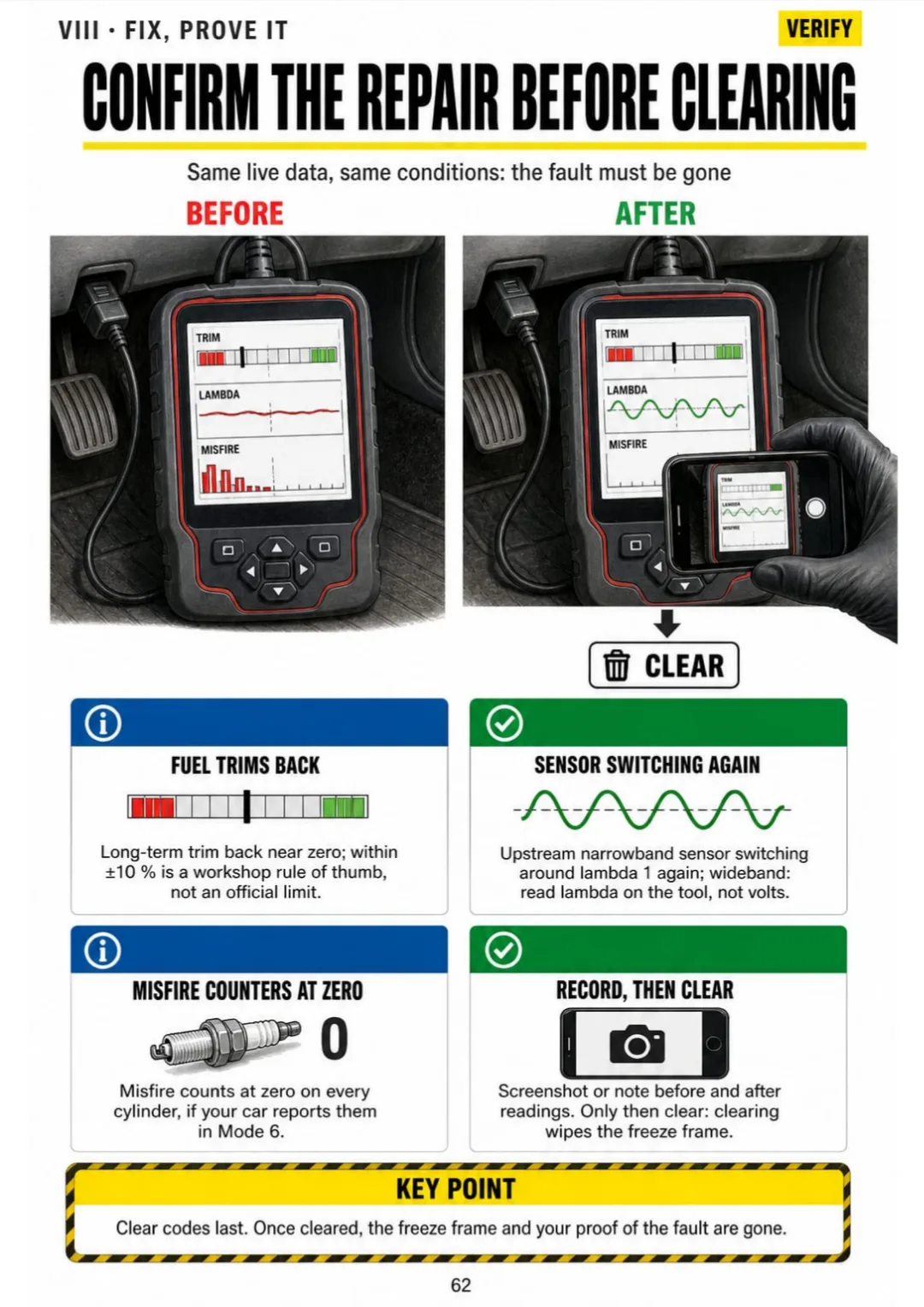
Before and after: trims, lambda switching and misfire counts checked before clearing codes

Swipe to see more →

These are real pages from the book. The table of contents is the full one: 8 parts and 63 topics.

The Problem Isn't You. It's How It Was Explained to You.

You're looking at the upstream lambda graph on a petrol hatchback with P0133 stored, and the line is drifting between 0.3 and 0.5 V. Lazy sensor, or an engine that's running lean?

The manual gives you three paragraphs on zirconia, reference air and stoichiometric ratios. Not one picture of what a healthy signal looks like. So you guess, and a new sensor goes on the order.

Good narrowband: 0.1–0.9 V, many switches every 10 seconds at 2,500 rpm

Here the narrowband sensor is one page: the good trace drawn next to the lazy one, 0.1 to 0.9 V, and in a box how many times it should switch in 10 seconds at 2,500 rpm.

Fuel trims, P0420 with its two sensors, the P0300 swap test, P0128 and the thermostat, diesel rail pressure: each one has its own page, laid out the same way.

You read the trace, you know what to test, and you decide before you order the part, without going back to the manual or the forums.

COMPARE FOR YOURSELF

The Same Topic, Two Ways to Learn It

THIS
  • The manual: line after line
  • Fuel trims explained only in words
  • You get to the car still unsure
Fuel trim represents the adaptive correction applied by the engine control module to the base injection quantity in order to maintain a stoichiometric air-fuel ratio during closed-loop operation. Short-term fuel trim responds continuously to the oxygen sensor feedback signal, whereas long-term fuel trim stores learned corrections across defined load and speed cells. A positive value indicates additional fuel commanded to compensate for a detected lean condition, while a negative value denotes fuel removal in response to a rich condition, total correction being the sum of both parameters.
FOR THIS
  • Fuel trims in one drawing
  • Plus and minus values in a box
  • You see it and you get it
STFT + LTFT = total correction: plus is lean, minus is rich.
CONTENTS

Take a Look at the 8 Parts and 63 Topics

Reading a code properly, fuel trims and air metering, lambda sensors and the catalyst, misfires and timing, cooling, EGR, EVAP and idle, diesel codes, circuit codes and wiring, and proving the fix: 67 pages, all illustrated.

IReading a Code Properly · pp. 5-13
  1. What EOBD Covers on UK Cars
  2. Anatomy of a Fault Code
  3. Generic or Manufacturer Code: How to Tell
  4. Steady MIL or Flashing MIL
  5. Pending, Confirmed and Permanent Codes
  6. Readiness Monitors After Clearing
  7. The 7-Step Method
  8. Freeze Frame: The Snapshot You Skip
  9. The Live Data PIDs Worth Watching
IIFuel Trims and Air Metering · pp. 14-22
  1. Fuel Trims in Plain Words
  2. Idle vs 2,500 rpm: The Trim Test
  3. P0171: System Too Lean, Bank 1
  4. P0172: System Too Rich, Bank 1
  5. P0171 + P0174: Both Banks Lean
  6. P0101: MAF Range/Performance
  7. P0106: MAP Range/Performance
  8. P0112 / P0113: Intake Air Temperature Circuit
  9. Smoke Testing for Vacuum Leaks
IIILambda Sensors and the Catalyst · pp. 23-29
  1. Narrowband Sensor: The Good Switching Signal
  2. Wideband Sensors: Read Lambda, Not Volts
  3. P0130–P0134: Upstream Sensor Circuit and Response
  4. P0135 / P0141: Lambda Heater Circuit
  5. The Downstream Sensor's Real Job
  6. P0420: Catalyst Efficiency Below Threshold
  7. Exhaust Leaks That Fake a Lean Code
IVMisfires, Ignition and Timing · pp. 30-39
  1. P0300: Random or Multiple Misfire
  2. P0301–P0306: The Swap Test
  3. Misfire Counters and Mode 6
  4. Coil-on-Plug Checks
  5. Reading a Spark Plug
  6. Injector Tests
  7. Compression and Leak-Down
  8. P0335: Crankshaft Position Sensor
  9. P0340: Camshaft Position Sensor
  10. P0016: Crank/Cam Correlation
VCooling, EGR, EVAP and Idle · pp. 40-46
  1. P0128: Coolant Below Thermostat Temperature
  2. P0117 / P0118: Coolant Sensor Circuit
  3. P0401: EGR Flow Insufficient (Petrol)
  4. P0455 / P0456: EVAP Large and Small Leaks
  5. P0443 / P0441: Purge Valve and Purge Flow
  6. P0505–P0507: Idle Control and High Idle
  7. P0562: System Voltage Low
VIDiesel Codes · pp. 47-56
  1. What Changes on a Diesel
  2. P0087: Rail Pressure Too Low
  3. P0088 / P0093: Pressure Too High and Fuel Leak
  4. P0299: Turbo Underboost
  5. P0234: Turbo Overboost
  6. P0401 on a Diesel: The Carboned EGR
  7. P2002 / P2463: DPF Efficiency and Soot Load
  8. P2452–P2454: DPF Pressure Sensor
  9. P0380 / P0670: Glow Plugs and Control Module
  10. SCR and AdBlue Codes: How to Recognise Them
VIICircuit Codes and Wiring · pp. 57-61
  1. Low Input, High Input, Circuit: What They Mean
  2. The Three-Wire Sensor: Supply, Signal, Earth
  3. Voltage Drop on Earths and Feeds
  4. Shared 5 V Reference: Several Codes at Once
  5. U0100 and Lost Communication Codes
VIIIFix, Prove It, Explain It · pp. 62-67
  1. Confirming the Repair Before You Clear
  2. The Road Test That Proves the Fix
  3. Explaining the Fault to the Customer
  4. Ten Parts Fitted for Nothing
  5. Checklist Before You Order a Part
  6. Quick Index: Code → Page → First Test

One Page, One Topic, All Clear

Think of it this way:

A car comes in with P0171 and the customer wants to know today if it's the MAF. You need to know where to look first, not after the part has arrived.

You open the P0171 page and see the trims drawn at idle and at 2,500 rpm: lean at idle that improves with revs points to a vacuum leak; lean that gets worse points to fuel or air metering.

P0128: a slow climb or a motorway drop on the coolant PID means thermostat stuck open

Same with the lambda signal, P0420, the P0300 swap test, diesel rail pressure and the three-wire sensor: each one on its own page.

OBD Fault Codes Illustrated is 67 illustrated pages in 8 parts: 63 topics, each on its own page, ending with the checklist before you order a part and a quick index from code to first test.

What you see drawn, you don't have to memorize.

What's Inside OBD Fault Codes Illustrated:

Ipp. 5-13

Reading a Code Properly

What EOBD covers on UK cars, how a code is built, generic or manufacturer, steady or flashing MIL, pending and permanent codes, readiness monitors, the 7-step method, freeze frame and the PIDs worth watching.

IIpp. 14-22

Fuel Trims and Air Metering

Fuel trims in plain words, the idle vs 2,500 rpm test, lean and rich codes on one or both banks, MAF, MAP and intake air temperature, and smoke testing for vacuum leaks.

IIIpp. 23-29

Lambda Sensors and the Catalyst

The good narrowband signal, reading wideband sensors in lambda, upstream sensor and heater codes, the downstream sensor's real job, P0420 and exhaust leaks that fake a lean code.

IVpp. 30-39

Misfires, Ignition and Timing

Random and single-cylinder misfires, the swap test, misfire counters and Mode 6, coils, spark plugs, injectors, compression and leak-down, crank and cam sensors and their correlation.

Vpp. 40-46

Cooling, EGR, EVAP and Idle

Coolant below thermostat temperature, coolant sensor circuit, petrol EGR flow, EVAP leaks, purge valve and flow, idle control and low system voltage.

VIpp. 47-56

Diesel Codes

What changes on a diesel, rail pressure low and high, turbo underboost and overboost, the carboned EGR, DPF efficiency, soot load and pressure sensor, glow plugs and how to recognise SCR and AdBlue codes.

VIIpp. 57-61

Circuit Codes and Wiring

What low input, high input and circuit mean, the three-wire sensor, voltage drop on earths and feeds, a shared 5 V reference behind several codes, and lost communication codes.

VIIIpp. 62-67

Fix, Prove It, Explain It

Confirming the repair before clearing, the road test that proves it, explaining the fault to the customer, ten parts fitted for nothing, the checklist before ordering and the quick index.

At the end of the book: A checklist before you order a part and a quick index: code → page → first test.
Plus: 2 Free Books

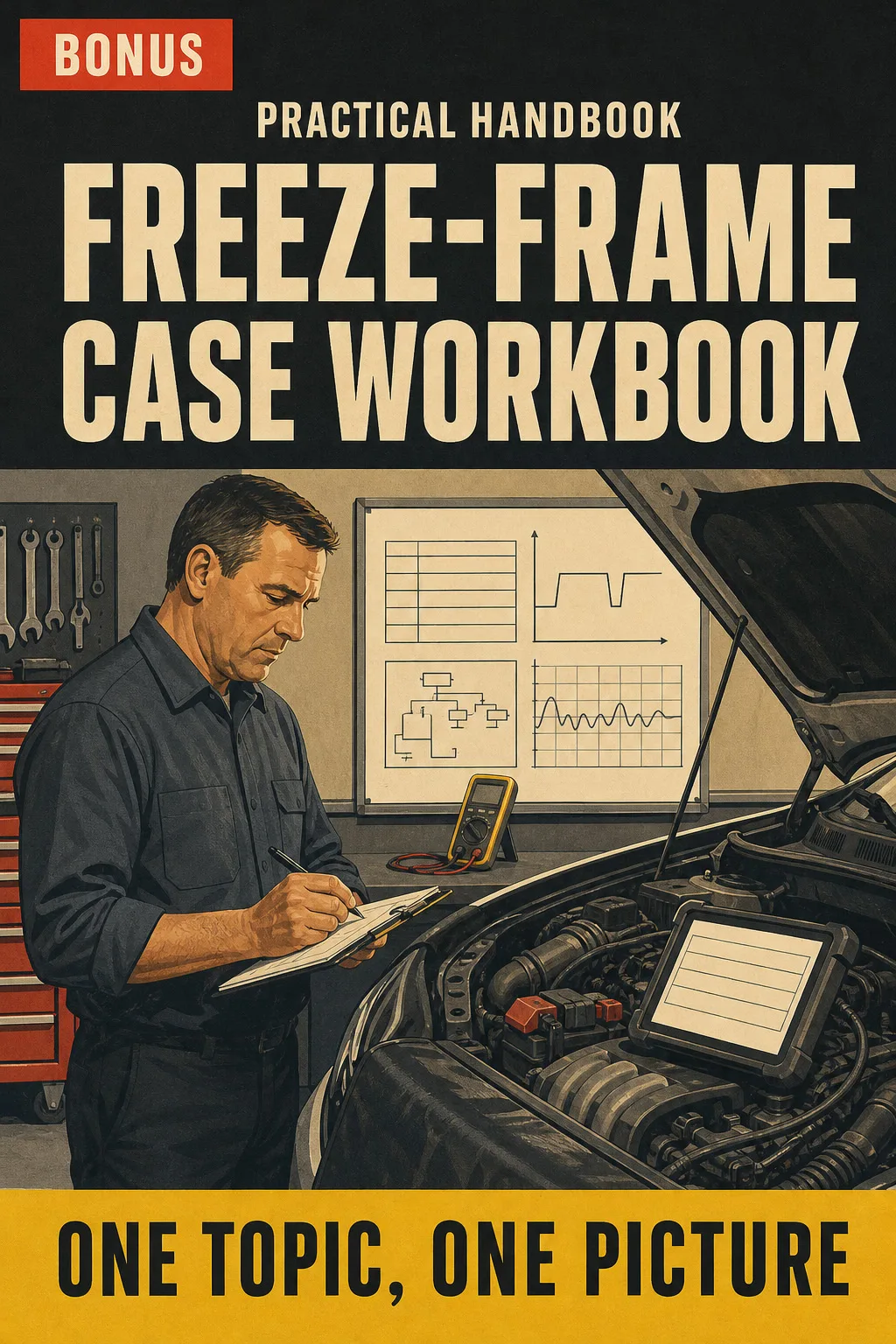
Freeze-Frame Case Workbook

BONUS 1: «Freeze-Frame Case Workbook»

Value on its own: US$ 17.90

Workshop-style cases with the code, the freeze frame and the live data: you decide what to test first, then check the answer on the next page.

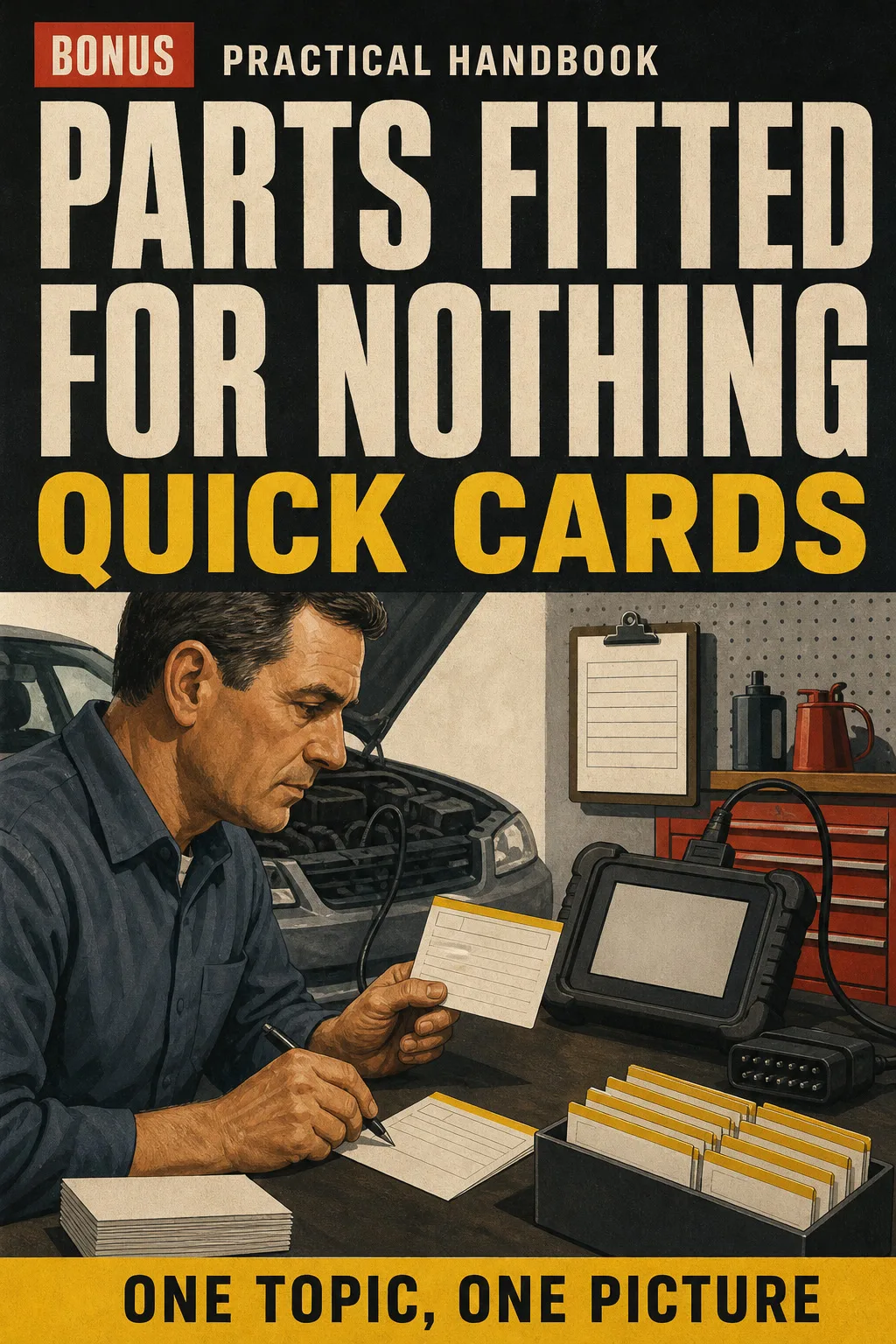
Parts Fitted for Nothing: Quick Cards

BONUS 2: «Parts Fitted for Nothing: Quick Cards»

Value on its own: US$ 14.90

The most frequent misdiagnoses, code by code, on printable cards for the toolbox, so you check the cheap test before you order the part.

OBD Fault Codes Illustrated with 2 Free Books

  • OBD Fault Codes Illustrated: 67 illustrated pagesUS$ 63
  • BONUS 1: Freeze-Frame Case WorkbookUS$ 17.90
  • BONUS 2: Parts Fitted for Nothing: Quick CardsUS$ 14.90
  • High-resolution PDF to printIncluded
Total value US$ 95.80
YOUR PRICE:
US$ 27
You save US$ 68.80
YES, I WANT OBD FAULT CODES ILLUSTRATED FOR US$ 27

📄 This is a digital PDF book sent to your email: nothing is printed or shipped.

Secure purchaseEncrypted payment30-day guarantee

PDF by email: We email you OBD Fault Codes Illustrated as a PDF, together with the two free books. It's a single payment: no installments, no extra charges.

Who This Book Is For

You fix your own cars and the family's

You fix your own cars and the family's

You've got the scan tool, now you get the test behind each code: what to measure, what a good reading looks like, before you buy anything.

A car's on the ramp with the light on

A car's on the ramp with the light on

You open the code's page, check the freeze frame and run the first test in the right order, with the part people fit for nothing marked.

You've run a workshop for years

You've run a workshop for years

Live data, fuel trims and lambda signals drawn on one page each, printed and kept on the bench for the jobs that don't add up.

Everything You Get Today

US$ 95.80US$ 27
YES, I WANT OBD FAULT CODES ILLUSTRATED FOR US$ 27

📄 This is a digital PDF book sent to your email: nothing is printed or shipped.

30DAYS
GUARANTEE

30-Day Guarantee

Try OBD Fault Codes Illustrated for 30 days, bonus books included.

We refund everything if the file won't open, if the book isn't what you see here, if you were charged twice or if the email doesn't arrive. Just email us.

You pay once. No subscriptions.

Frequently Asked Questions

Is it for me if I've been on the tools for years and already have a scan tool?

Yes. It isn't a beginner's list of codes: it's the test that comes before the part, code by code. It covers generic powertrain codes valid on any make, petrol and diesel, in metric units, and shows how to recognise manufacturer-specific codes. A generic scan tool with live data and freeze frame is enough; the Mode 6 pages need a tool that reads it.

Where does the content come from?

Code definitions are checked against the generic powertrain code list in SAE J2012 / ISO 15031-6 (the EOBD list used on UK cars), and the MIL rules against the DVSA MOT inspection manual. Values are typical ranges: always check the manufacturer's data for the car in front of you.

Is it official material?

No. It's an independent illustrated book. It isn't published, approved or endorsed by any standards body, government agency, vehicle manufacturer or scan tool brand.

Does it replace training or the manufacturer's data?

No. It's a study and workshop reference that puts each code's test in order. It doesn't replace professional training, workshop manuals or safe working practice.

Is it all American, or does it work on diesels and European cars?

It's written for UK cars: EOBD, petrol and diesel, in metric units. Generic P0 codes mean the same on any make. For manufacturer codes it shows how to recognise them and when to go to the maker's data for that car.

When and how does it arrive?

As a PDF by email, to the address you enter at checkout, together with the 2 bonus books.

Do I have to pay every month?

No. It's a one-off payment, no subscription.

Can I have it on paper?

Yes. Print it at home or at a print shop, the whole book or just the pages you want on the bench.

How does the refund work?

You have 30 days. We refund everything if the file won't open, if the book isn't what you see on this page, if you were charged twice or if the email doesn't arrive: just email us.

Before You Close This Page

No more forum threads that say ten different things.

The good lambda signal, you see it drawn and that's it.

You get to the car knowing where everything is.

Drawings make studying faster.

The book is right below.

One-time payment: US$ 27 · Guarantee: 30 days · PDF by email

YES, I WANT OBD FAULT CODES ILLUSTRATED FOR US$ 27

📄 This is a digital PDF book sent to your email: nothing is printed or shipped.